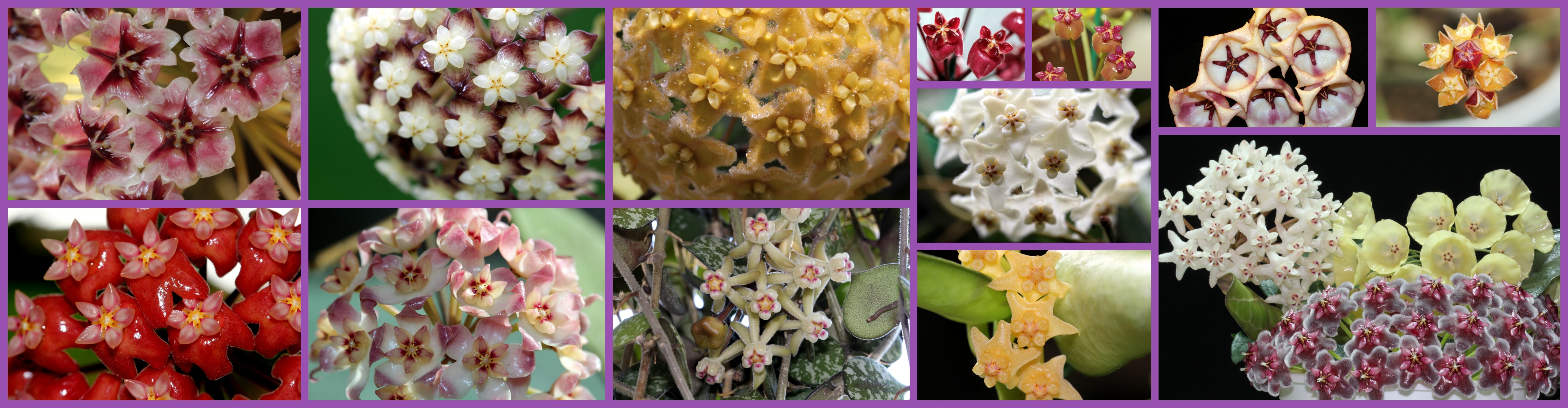
In Praise of Hoya sipitangensis

I have had this Hoya now for at least 7 or 8 years and it seems that every year that goes by, I like it more and more. This is a plant that can live in ambient conditions in the regular house, does not drip nectar, and just does its thing. You can’t ask much more than that out of a plant!

Final Day With Hoya liddleana

Once again all good things must come to an end, so herein is the end of the discussion of this wonderful plant. I’m super glad that thanks to Julie Kennedy, I got the chance to flower the last Hoya in the Macgillivrayi Complex. It is a great plant that flowers early and does not seem to take up that much room compared to other plants in the complex. Its care is easy and it is tough plant that can stand up to some abuse. I love the huge coronas that almost reach the outside of the corolla making it completely unique. Hoya liddleana gets my highest recommendation!

Hoya liddleana Showing The Entire Plant and 5,000th Post Reminisces

Here is a photo of the showing the entire plant after it flowered the first time; note how much smaller the leaves are than on other Hoyas in the same complex.

For good or bad, this particular post is my 5,000th. It took a lot of years to get here, and I’m unsure where I go from here. It was a goal that I wanted to achieve, and I finally made it! These daily posts have gone on for a very long time, and I may go to a more infrequent posting schedule in the future, but for now it is hard to let it go. Thanks to everyone who has stayed with me all of these years!

Growing Hoya liddleana Part Three

Hoya liddleana flowered for the first time with three blooms in January and has flowered four times since then. In nature this plant is purported to flower in March, but in my constantly lit grow tent it has flowered continually, and as of this writing, the plant currently has five flowers in July.

Growing Hoya liddleana Part Two

Within a few months I had moved the plant up to a 4 inch clear orchid pot with holes keeping the same mix. I noticed that of all the plants in the Macgillirayi Complex, H. liddleana seemed slightly less vigorous with noticeably smaller root ball. The plant produced its first peduncle in December and started to bud up in January of this year.

Growing Hoya liddleana Part One

The only Hoya in the Macgillivrayi Complex that I had yet to flower was Hoya liddleana, and that was because I had yet to obtain a specimen. This problem was solved by my good friend Julie Kennedy when she sent me a cutting in May of 2024. Despite a lengthy time in the post, the plant arrived in very good shape. I rooted it in coco husk chips mixed with a little pumice and lava rock. It fairly quickly rooted and began growing.

Hoya liddleana Is Named For David and Iris Marie Liddle

Hoya liddleana Is named for the Liddle’s of Mareeba Australia. David Liddle was and amateur plant scientist and collector who ran a plant nursery with his wife, Iris Marie. Mr. Liddle and Paul Forster described 15 new taxa together. After David died in 2009, his wife kept the plant nursery open for some time. In my early days in the hobby, I placed a number of orders with the nursery which were orchestrated as group orders with other collectors. He knew how to better ship unrooted cuttings better than anyone before, or since. I still have plants that originated with him; his passing was a huge blow to the hobby.

Hoya liddleana Is Similar To Hoya onychoides and Hoya stenaokei

From the type description: “Similar to the widespread (yet endemic to New Guinea) Hoya onychoides because both species have inflexed ‘claw-like’ corolla lobes and oblong corona lobes. They can be easily separated because the inner surface of the corolla of Hoya onychoides is glabrous (except a few scattered hairs inside at the base of the staminal corona and along margins) while in Hoya liddleana it is pubescent throughout inside. In Hoya onychoides the corona is distinctly conical and about as tall as wide, dark wine-red, while the corona of Hoya liddleana has a conical center with prominent spreading outer processes and it is about half as tall as wide, cream, with pink or maroon center. Hoya liddleana is also similar to the recently discovered Hoya ste­naokei Simonsson & Rodda (name improved, originally Hoya stenakei; IPNI 2021), once again endemic to New Guinea. Both species have the inner surface of the corolla pubescent. The two species can be separated based on the shape of the corolla (inflexed in Hoya liddleana and rotate in Hoya stenaokei) and the shape of the corona (star-shaped with lobes oblong and only basally bilobed at the outer tip in Hoya liddleana; almost pentagonal with lobes rhomboid and distinctly bilobed at the outer tip in Hoya stenaokei).” Thanks to Mary Carroll for providing this information.