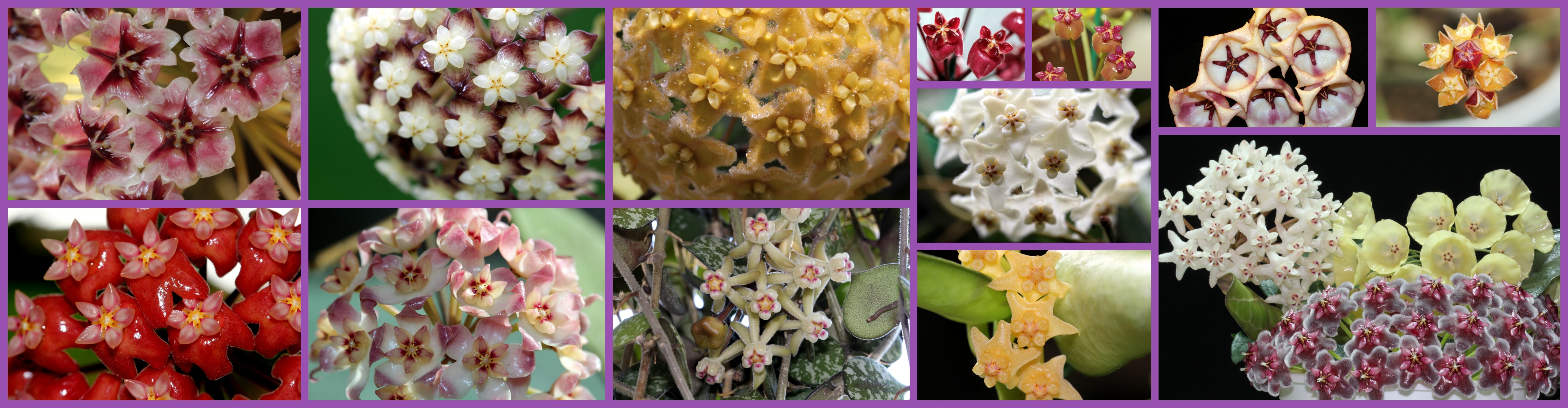

Hoya nicholsoniae was first collected on October 25, 1864 by John Dallachy in trees by the sea at Rockingham Bay, Queensland, Australia. It is a glabrous, twining epiphyte or lithophyte. Leaf blades fleshy to coriaceous, narrow-ovate to ovate, basally tapered, rounded or subcordate, usually green, red-brown when growing in strong light, 4-12 cm long by 2.5-7.0 cm wide, with 3 (to 5) acrodromous veins visible on the upper leaf surface, petioles 1.0-3.0 cm long, 4- 8 mm in diameter, often with a pale brown corky surface. Inflorescence umbellate with 10 to 30 flowers, peduncles 1-12 cm long, slender, pedicels 6-10 cm long, slender. Sepals triangular, 2-3 mm long. Corolla outer surface glabrous, inner surface densely puberulous, lobe margins and tips reflexed, 1.0-1.8 cm in diameter, yellow to green or brownish-pink. Corona to 6 mm in diameter, flat, with the center lower than the lobes; lobes ovate-lanceolate to rhomboid, slightly longitudinally ridged above, with two longitudinal, inrolled keels extending the full length below, to 0.4 cm long, 0.2 cm wide, white to cream to green tinged with pale pink. Fruit 8-15 cm long, 0.7-1.2 cm in diameter. It is a widespread and relatively abundant epiphyte or lithophyte in rainforests of northeastern Queensland, at low and high altitudes. It is also known in New Guinea, New Caledonia, Samoa, and the Solomon Islands. It also occurs epiphytically in mangrove communities. Named in honor of Dominae Nicholson, referring to Lady Nicholson, the most excellent wife of Baronet Charles Nicholson, Sarah Elizabeth Keightley.
Heterotypic synonyms – Hoya cominsii Hemsl. in Ann. Bot. (Oxford) 5: 505 (1891), Hoya cominsii Hemsl. in Ann. Bot. (Oxford) 5: 505 (1891), Hoya limoniaca S.Moore in J. Linn. Soc., Bot. 45: 368 (1921), Hoya neocaledonica Schltr. in Beibl. Bot. Jahrb. Syst. 92: 245 (1906),Hoya pycnophylla Rech. in Repert. Spec. Nov. Regni Veg. 5: 133 (1908), Hoya samoensis Seem. in Fl. Vit.: 163 (1866), Hoya samoensis subsp. savaiiensis Kloppenb. in Hoya New 6(2): 26 (2017), Hoya sogerensis S.Moore in J. Bot. 52: 293 (1914), Hoya upoluensis Reinecke in Bot. Jahrb. Syst. 25: 669 (1898), and Hoya upoluensis f. minor Reinecke in Bot. Jahrb. Syst. 25: 669 (1898).
In 2007 and 2009, respectively, I purchased Hoya nicholsoniae as two different species, Hoya hellwigiana and Hoya samoensis, from Liddle Nursery in Australia. As of 2022, both of these plants are now considered synonyms for Hoya nicholsoniae. Over the years, both plants grew unproblematically in various substrates. I believe this Hoya is one of the best for beginners due to its easy culture and early flowering.
UPDATE 2027: It has been a few years since I grew this one, but it remained an easy growing favorite for some time.


