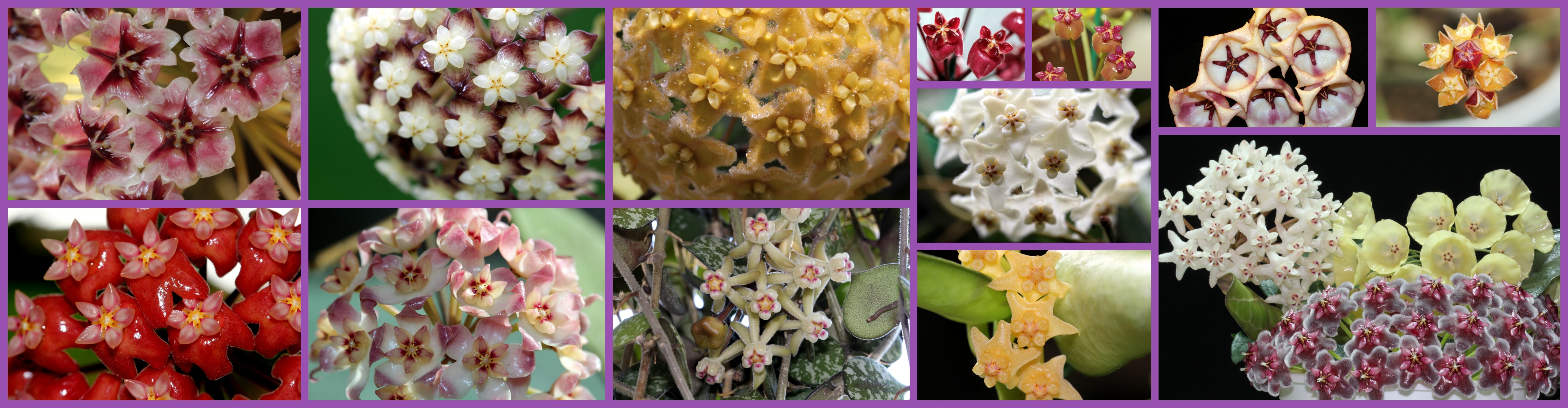
I purchased a small plant from The Peace and Happiness Club, a plant vendor, in the summer of 2023. I was so excited to be able to get a chance to grow a plant with such unusual flowers. The rooted cutting was exceptionally vigorous and grew quickly. It went through several up-pottings and required copious amounts of water to keep the mix hydrated. I did not realize at the time that there was more than one clone of this plant, and only found out later that this one had the accession number IM-04 and was only discovered in 2021.
“When not in flower, H. paradisea can be confused with many other New Guinean species with similar plain green, coriaceous leaves, for example H. apoda S.Moore, H. evelinae Simonsson & Rodda, H. leucantha S.Moore, H. oreostemma Schltr., and H. solaniflora Schltr. Their flowers show a great diversity in both size, shape, color and orientation, but none of them have corolla lobes with 3 mm long hairs.”
“An epiphytic climber in lowland primary riverine forest, often growing near the ground or near streams on trees and shrubs. At the type locality it was not observed in taller trees or sunnier and drier spots, only in shade or filtered sunlight.”
In 2021 a variation of Hoya paradisea was discovered from the Mimika regency in Indonesian Papua province (Mt Timika area). This variation has the accession number IM-04 and can be seen below:
Hoya paradisea was first discovered in 2011 by Nathalie Evelinadotter Simonsson and Fredrik Juhonewe in Papua New Guinea, Western Province, Black River near Dahamo village, around 100 m in lowland primary forest, given the accession number NS 11-159, and vouchered in cultivation in Stockholm, Sweden.
I don’t know why it has taken me so long to discuss this fabulous species. Perhaps it is because there are two different clones of it in the trade, and I wanted to flower them both before I brought it to you, but whatever the reason tomorrow I will finally begin detailing my experiences with it. For now, here is a teaser photo of it:
Hoya cinnamomifolia is now considered a synonym for Hoya macrophylla. Michele Rodda has published a recent paper (2025) that goes into great detail about how a erroneous illustration led to the misidentification of Hoya macrophylla. Here is an abstract from the published paper:
“ABSTRACT. Accurate botanical illustrations play a crucial role in plant identification. Hoya macrophylla Blume, one of the earliest described species of Hoya R.Br. from Southeast Asia, and among the earliest to be illustrated, presents significant identification challenges. This paper elucidates how its first illustration incorporates features characteristic of both Hoya macrophylla and H. latifolia G.Don, and this is the reason behind the difficult application of the name. Furthermore, the type specimen of Hoya macrophylla is indistinguishable from H. cinnamomifolia Hook., a taxon published later and consistently correctly applied. This study underscores the need for careful re-evaluation of historical illustrations in the context of modern taxonomic standards. A lectotype and an epitype are designated for Hoya macrophylla and H. latifolia respectively and their synonyms are clarified and where necessary typified.“