I am very impressed with the results of my first try with drying Hoya flowers. The flowers retained their color and stayed open without closing up. I have now started a larger test with even more flowers that I will be interested to bring to you in a few weeks. I once again want to thank Rachel Mixon for suggesting this project and for providing the flower drying kit!
I was looking for something new to post and found this one flowering this morning. This is another plant that somehow I ended up with a duplicate, and both specimens of flowering right now.
I’m not really sure why I still keep this Hoya, but I do, and here is a rare number of flowers on a single peduncle. Usually there is only one or two so here we are with three.
I’m not sure if I have shown these prints before or not, but about a year ago I framed all 12 of Cynthia Bauzon-Arre’s post cards of Philippine Endemic Hoyas. One of the post cards recently fell from its hinged mount so I had to tear it apart, and reframe it, so I thought that I would snap a photo of it after I completed the project. I was a picture framer in what seems like a previous life, and occasionally the know how comes in handy!
This plant is probable 2 1/2 feet in circumference and around 3 1/2 feet tall and covered with buds and flowers, which really needs to be seen in person to appreciate.
I absolutely must spend a little time documenting this incredible Hoya yvesrocheri. It is in all likelihood destined to be chopped up in the spring as it has outgrown my ability to care for it properly at its current size.
A few weeks ago Rachel Mixon from YouTube interviewed me about Hoya blooms. For those who have not seen it here is the link: https://www.youtube.com/watch?v=GAirlr_C1gI&t=37s During the discussion she indicated that I might want to try preserving my blooms using silica gel, and she was kind enough to send me a gift of a five pound bag of the crystals. My first try will be using it on these H. calycina ‘Stargazer’ blooms; I have attached a photo below before fully covering the flowers. I will report back in a couple of weeks on the outcome. It will be interesting to see if it prevents blackening, retains the red color near the corona, and stops the flower from reflexing into a ball.
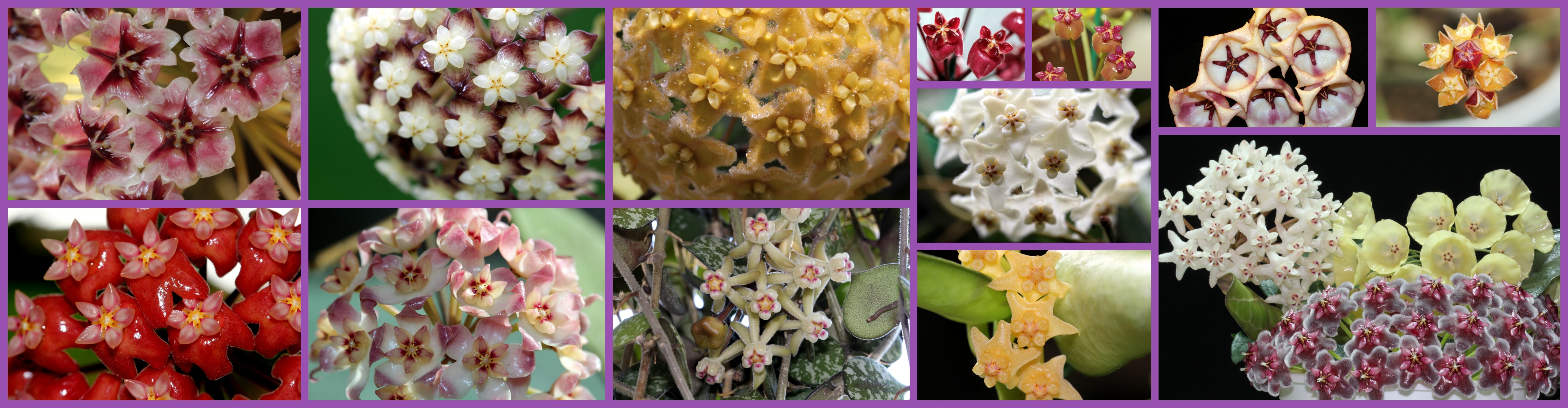
Time goes by so quickly, and the older you get the faster it flies by. This is my annual lookback at the highlights of the previous year, so without further adieu, here are the high points of my 2025 year in Hoyas:
We began 2025 in January with my first time flowering of the variegated Hoya cumingiana and ended it discussing the dark form of Hoya stenaokei;
February brought us the first time flowering of Hoya microstemma, and Hoya tsangii:
The highlight of March was the flowering of Hoya microphylla!
April 2025 we explored both Hoya pulchra and Hoya medusa, both of which flowered for the first time.
The highlight of May 2025 was the apple green flowers of Hoya griffithii LT08-026:
June brought us Hoya sp. aff. Vitiensis NS05-021 this is a plant that I am now struggling mightily to grow:
July into August brought the flowers of Hoya liddleana, the final Hoya I had to flower in the Macgillivrayi Complex:
Late into August and early September shows the incredible flowers of Hoya paradisea!
September also brought us the flowers of Hoya sp. Bengkulu (Rindu Rafflesia)
The highlight of October was definitely the first flowering of Hoya chloroleuca:
November was all about Hoya polyneura (Outer Variegated)!
Finally December ended with the first time flowering of Hoya pulleana:
Once again thank you for taking a look at my year in review for 2025; tomorrow we start yet another year in Hoyas. The best to all of you and your plants in 2026!!!